Introduction
Estimating an IT project is rarely a single number you can paste into a spreadsheet and call the job done. For founders and product leaders it is primarily a decision‑making process under uncertainty. It isn’t just “how much will it cost?” – it’s also about understanding what scope truly needs to be delivered, which elements are critical, and how quickly the team can generate business value. A solid estimate structures the conversation between business and engineering and helps avoid launching a project with unrealistic expectations.
In practice, estimation works best when it results from a joint effort on assumptions, constraints and priorities. The earlier ambiguities are uncovered, the lower the risk of costly changes later. Founders, CTOs and product owners don’t need to know every technical detail, but they should understand where the estimate range comes from and which decisions can shift it.
Business Problem
Many organisations start a project assuming a single price quote will close the discussion. The problem appears when the scope is described at a vision level rather than concrete user‑scenario level. Consequently, the team is asked to price something that still needs clarification. Business interprets the number as a promise; the team sees it as a rough approximation. This expectation gap creates tension after just a few sprints.
A second common issue is mixing estimation with budget negotiation. When the conversation focuses solely on “fitting into a given budget”, there is a temptation to down‑play risks, skip integrations or assume an overly optimistic velocity. It may look good on a slide, but later it leads to scope reductions, quality compromises or uncontrolled scope creep. From a business perspective it is better to know the realistic cost and consciously decide what belongs in the MVP, rather than build a plan on an overly optimistic scenario.
Technical Explanation
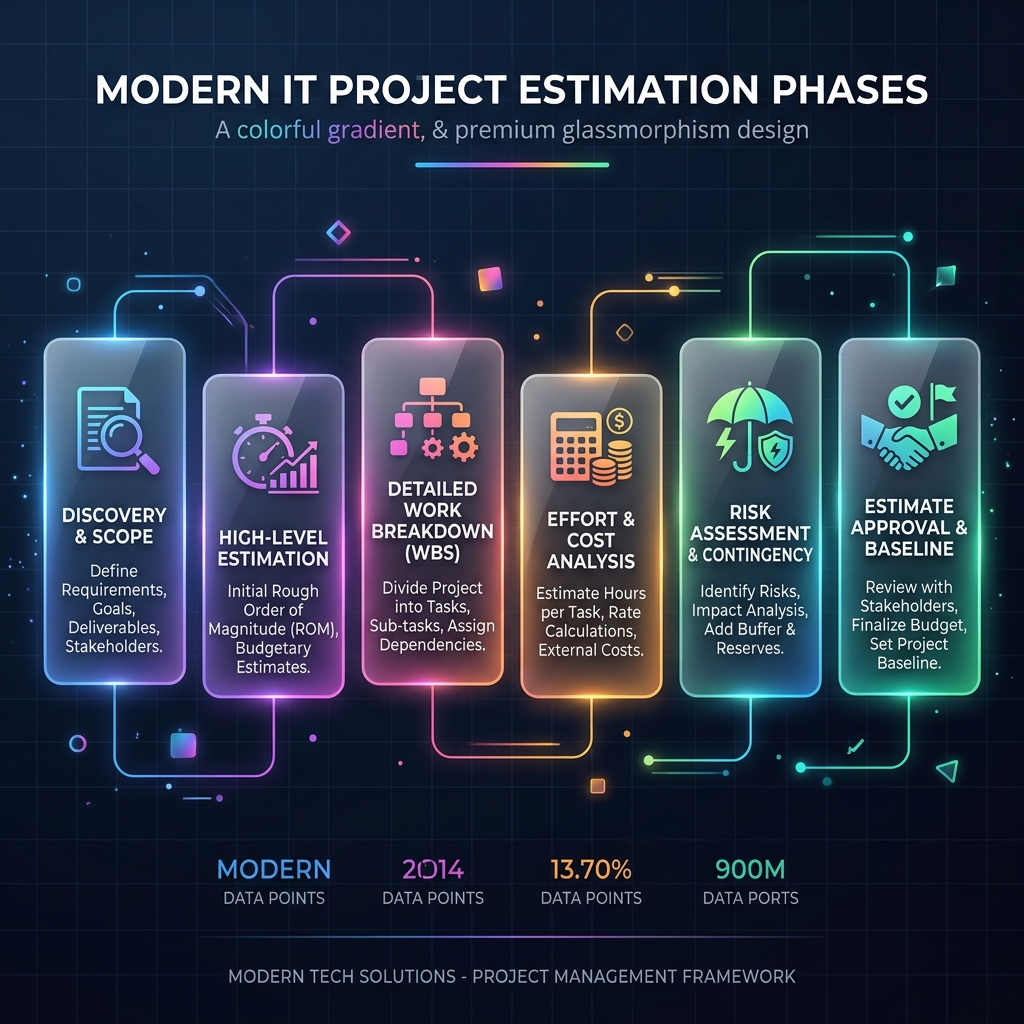
Technically a good estimate starts with breaking the project into smaller pieces – epics, business processes, system modules or value streams. For each piece the team assesses complexity, dependencies, unknown areas and integration risks. At this stage it is crucial to distinguish obvious features from those that require prototyping, workshops or additional architectural decisions.
In practice it is useful to work with ranges instead of a single figure. The team can prepare a conservative (pessimistic) variant and an optimistic variant, then indicate the conditions under which the project will move toward either. Highlighting high‑risk items – e.g., external API integrations, data migrations or client‑system dependencies – gives a more realistic picture than a flat price without context.
Equally important is accounting for non‑development work that is essential for delivery: analysis, QA, DevOps, environment setup, monitoring and rollout support. These areas often disappear from simplified estimates, despite their real impact on cost and schedule. A good estimate shows the full effort needed to launch a product, not just the number of screens or endpoints.
Practical Example
Suppose a founder plans an online consultation‑booking platform for B2B customers. At a high level the project looks simple: client panel, calendar, payments, notifications and an admin dashboard. When the team digs deeper, questions quickly arise: does the calendar need to support multiple time zones? Will payments be one‑off or subscription‑based? Can an admin manage multiple company accounts? What are the security requirements and reporting needs?
During estimation the team can split the work into streams: user onboarding, scheduling, billing, admin panel, integrations and infrastructure. Each stream gets its own scope, risks and assumptions. This way the founder sees that the MVP does not need to include every possible report, and the first payment implementation can support a single method instead of five. The estimate therefore becomes a tool for conscious scope trimming rather than merely a cost answer.
Common Mistakes
- Estimating too early – before the team understands business goals and key user scenarios. Numbers become intuition‑driven rather than analysis‑driven.
- Ignoring technical risks – especially integrations with external systems. A one‑sentence integration description should carry an explicit uncertainty margin.
- Treating MVP as “the cheapest version” – an MVP is not a random cut of features, but the smallest viable slice that validates a hypothesis. Stripping too much may render the product useless, and even a perfect estimate cannot rescue it.
- Overlooking coordination, testing and rollout costs – plans look good on paper but fall apart when these hidden costs appear.
Recommendations
Treat estimation as a dedicated preparatory stage. Even a short discovery sprint helps organise requirements, identify risks and build a list of assumptions that can later be validated. Present the estimate together with a description of scope, constraints and risks – not as an isolated number detached from context.
It is also useful to prepare two views:
- Business view – shows cost, timeline and possible scope variants.
- Operational view – details concrete work areas and dependencies.
This structure streamlines stakeholder conversations and enables faster priority decisions. If some assumptions remain uncertain, write them down openly rather than hiding uncertainty behind a veneer of precision.
Summary
IT project estimation is not a guess‑work exercise; it is a way to organise product and technical decisions. The more the team understands the business problem, the MVP scope and risk areas, the more useful the estimate becomes. Founders and product leaders then receive not only a cost figure but also a map of dependencies, constraints and trade‑offs, leading to fewer disappointments during execution and better control over what actually gets delivered.